Workshop Combinatorics meets Coxeter Groups (CCG)
Bielefeld University
30. Sep. — 02. Oct.
Plenary Speakers
| Christian Stump | Olga Varghese | María Cumplido |
Organizers
| Sebastian Degen | Leonie Mühlherr | Marcel Palmer |
About CCG
The combinatorics related to Coxeter groups play a crucial role in many areas of algebra such as graph theory, hyperplane arrangement theory, matroid theory, building theory and many more. This conference explores this crossroads, in particular its aim is to highlight the importance of combinatorial methods for approaching Coxeter group related topics, such as in the recent developments concerning Chow polynomials arising from Coxeter groups. The focus of this workshop is to foster new and existing connections between young researchers in algebra and combinatorics by giving them the opportunity to meet, exchange and start new collaborations.
The workshop starts on Wednesday (30.09) at 9:30 a.m. and ends Friday (02.10) in the afternoon.
Schedule
| Time | Wednesday | Thursday | Friday |
|---|---|---|---|
| 9:30 - 10:00 | Registration |
María Cumplido (Plenary) |
|
| 10:00 - 10:30 | Torben Wiedemann |
Christian Stump (Plenary) |
|
| 10:30 - 11:00 | Artem Polev | Coffee Break | |
| 11:00 - 11:30 | Coffee Break | Coffee Break | Lewis Dean |
| 11:30 - 12:00 |
Olga Varghese (Plenary) |
Kyle Huang | Marina Salamero |
| 12:00 - 12:30 | Ahmad Ibrahim | Maximilian Kaipel | |
| 12:30 - 14:00 | Lunch Break | Lunch Break* | Lunch Break |
| 14:00 - 14:30 | Owen Garnier | Dante Luber | |
| 14:30 - 15:00 | Damian de la Fuente | Islam Foniqi | Social activity (open End) |
| 15:00 - 15:30 | Coffee Break | Coffee Break | |
| 15:30 - 16:00 | Philipp Lehnhardt | Collaboration space | |
| 16:00 - 16:30 | Peter Abramenko | ||
| 16:30 - 18:00 | |||
| Conf. Dinner: 19:00 |
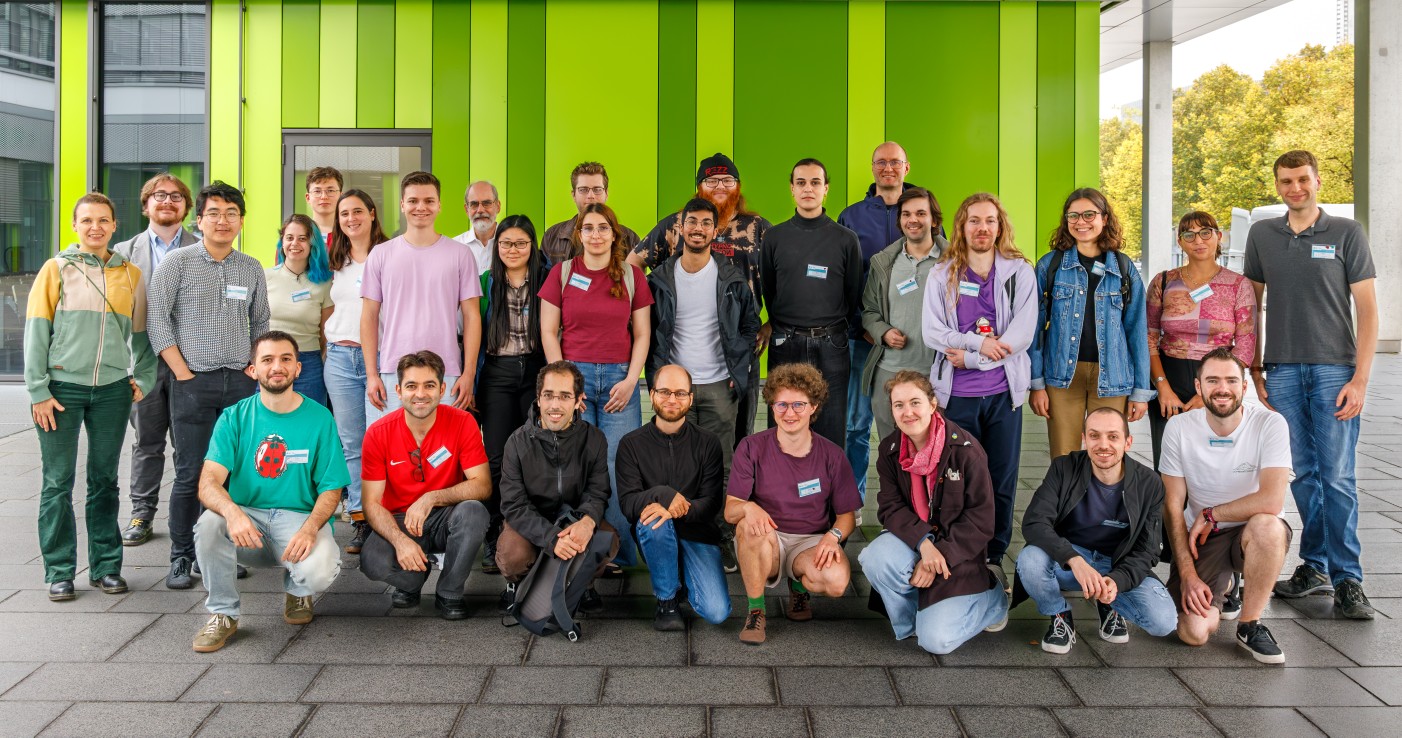
* The conference picture will be taken during Thursday's lunch break.
Registration
The registration is closed.
The funding application is now closed.
Poster
Location
All talks will be in the lecture hall X-E0-002 in the X building of the University. (Lageplan X-Gebäude)
Sponsors / Acknowledgments
This conference is funded by the TRR 358 "Integral Structures in Geometry and Representation Theory" as well as by the SPP 2458 "Combinatorial Synergies".
Titles & Abstracts
Plenary Speakers
Olga Varghese: On finite quotients of Coxeter groups
Abstract: We prove several results concerning profinite completions of Coxeter groups. In particular, we show that Coxeter groups are good in the sense of Serre. As a key application, we show that several families of Coxeter groups are profinitely rigid amongst Coxeter groups.
Christian Stump: Polynomials are great combinatorial invariants
Abstract: In this talk, I present multiple recently defined families of polynomials associated to a finite graded bounded poset, namely the Poincaré-extended ab-index, the flag coarse Hilbert-Poincaré series, and the Chow polynomial. I discuss their properties such as their unimodality, log-concavity, gamma-positivity, and real-rootedness. Most importantly, I present interesting conjectures (and, maybe, partial results) for their properties for noncrossing partition lattices associated to finite Coxeter groups.
María Cumplido: Artin groups that admit retractions to parabolic subgroups
Abstract: An Artin group is a group generated by a finite set of (standard) generators subject to relations of the type $sts \cdots = tst\cdots$ , where both sides of the equality have the same number of letters. A (standard) parabolic subgroup is a subgroup generated by a subset of generators, which is again an Artin group. We say that an Artin group admits a retraction onto a parabolic subgroup if there exists a retraction homomorphism from the Artin group onto that parabolic subgroup. In this work, we classify the Artin groups admitting such retractions. We also prove that whenever such a retraction exists, there always exists a retraction sending standard generators to standard generators or identity. This is joint work with B. A. Cisneros de la Cruz, I. Foniqi, and L. Paris.
Wednesday Contributed Talks
Torben Wiedemann: Introduction to reflection groups and Coxeter groups
Abstract: This talk introduces the notion of finite (real) reflection groups (that is, finite Coxeter groups). We will cover their relationship to finite root systems and Coxeter diagrams, study some examples and give an overview of their classification. At the end of the talk, we will also briefly discuss non-finite Coxeter groups.
Introduction to Coxetergroups
Handout Slides
Artem Polev: An introduction to buildings
Abstract: In the study of groups with BN-pairs and the study of CAT(0)-spaces a commonly appearing geometric object is the Bruhat-Tits building. We are going to discuss some examples and how they tie into Coxeter groups.
Owen Garnier: Normalisers of parabolic subgroups and universal covering
Abstract: Normalisers of parabolic subgroups in Coxeter groups are described combinatorially by a groupoid whose construction is due to Brink and Howlett. In a joint work with E.Heng, A.Licata and O.Yacobi, we determined the universal covering of the Brink-Howlett groupoid in terms of the combinatorics of the Tits cone intersection, which is a relative version of the usual Tits cone adapted to a standard parabolic subgroup. As a consequence, we obtained a Matsumoto-like property for the Brink-Howlett groupoid. In this talk, I will present this joint work, with an emphasis on the combinatorics of the Tits cone intersection and on groupoid coverings. If time permits, I will also mention other results we obtained on the associated Artin group in the case of a finite Coxeter group.
Damian de la Fuente: Counting lower Bruhat intervals in affine Weyl groups
Abstract: The Bruhat order on a Weyl group arises naturally from geometry via the inclusion relations between Schubert varieties, but it can also be defined combinatorially in the broader context of Coxeter systems. It plays a central role in Kazhdan–Lusztig theory, where it is used to define the remarkable Kazhdan–Lusztig basis and polynomials. Many fundamental questions about this partial order remain open; for instance, the combinatorial invariance conjecture asserts that Kazhdan–Lusztig polynomials are completely determined by the poset structure of the underlying Bruhat intervals. In this talk, we will focus on the study of lower Bruhat intervals (starting at the identity) in the case of affine Weyl groups and, in particular, on computing their cardinality. First, we will describe certain lower intervals by decomposing them in terms of lattice points in permutohedra. From this, we will deduce a polynomial counting formula for the size of such intervals, expressed as a linear combination of the volumes of the faces of these polytopes. Second, we will generalize these results to almost all lower intervals: those coming from the lowest Kazhdan–Lusztig two-sided cell. The main objects of study will be certain sets we call “Paper Boats,” which will serve as the fundamental building blocks to construct these intervals. This work is part of an ongoing collaboration with F. Castillo, N. Libedinsky and D. Plaza.
Philipp Lehnhardt: Generalized root systems
Abstract: My talk will provide an introduction to the concept of generalized root systems (GRS) as introduced by I. Dimitrov and R. Fioresi as well as outline my recent computer-algebra-free proof of their conjecture that GRSs in rank $\geq 2$ are equivalent to quotients of ordinary root systems.
Peter Abramenko: {i,j}-subgraphs of buildings and certain alternating products in Coxeter groups
Abstract: Let $X$ be a building of type $(W,S)$, where $(W,S)$ is a Coxeter system with $S = \{s_i \;|\; i \in I\}$. Then $I$ can be used as the set of types of the vertices of $X$. The set of all vertices of type $i$ or $j$ (with two different elements $i$ and $j$ of $I$), with two vertices connected if they form an edge in $X$, becomes a bipartite graph $G = G(i,j)$ with interesting properties. One of these (but not the only one) is that the girth of $G(i,j)$ is precisely $2m_{i,j}$, where $m_{i,j}$ is the order of $s_is_j$ (so $G(i,j)$ is a tree if $m_{i,j}$ is infinite). An important tool in deriving these properties consists in analyzing alternating products in $W$ of the following form: Set, for any subset $K$ of $I$, $W_K = \langle s_k \;|\; k \in K \rangle$. Then set $W_i' = (W_I\setminus\{i\}) \setminus (W_I\setminus\{i,j\})$, $W_j' = (W_I\setminus\{j\}) \setminus (W_I\setminus\{i,j\})$, $P_n = \{w_1...w_n \;|\; w_m \in W_i' \;\text{for all odd}\; m \;\text{and}\; w_m \in W_j' \;\text{for all even}\; m\}$, respectively, $Q_n = \{w_1...w_n \;|\; w_m \in W_j' \;\text{for all odd}\; m \;\text{and}\; w_m \in W_i' \;\text{for all even}\; m\}$. Using Tits's solution of the word problem for Coxeter groups one can show that the intersection of $P_n$ and $Q_n$ is empty if $n < m_{i,j}$, which implies that $G(i,j)$ has girth $2m_{i,j}$. Other properties of $G(i,j)$ can also be deduced by analyzing the intersection of $P_n$ and $Q_n$ for $n = m_{i,j}$.
Thursday Contributed Talks
Kyle Huang: UniTriSat: Unimodular Triangulations via SATISFIABILITY
Abstract: Given a lattice polytope, it is natural to ask if it has a unimodular triangulation. Unimodular triangulations have connections to toric geometry, tropical geometry, and enumerative combinatorics, while also being an interesting property in their own right, for various classes of lattice polytopes. With the Julia package UniTriSat, we present a new algorithm for computing unimodular triangulations (and regular/flag unimodular triangulations), via translation to a SATISFIABILITY problem. This is joint work with Robert Lauff and Charles Zhang.
Ahmad Ibrahim: FFLV polytopes for covariant representations of $\mathfrak{gl}(m|n)$
Abstract: The classical FFLV polytope is given as a marked chain polytope of the Gelfand-Tsetlin posets ordering the positive roots of the type $A_n$ or type $C_n$ root system. This polytope provides a monomial basis of the finite-dimensional highest weight representation of the corresponding $A_n/C_n$ simple Lie algebras. In joint work with Pranav Enugandla, we constructed new lattice polytopes based on an extension of the classical Dyck path model whose lattice points parametrise new bases of new covariant representations of the Lie superalgebra $\mathfrak{gl}(m|n)$.
arXiv: https://arxiv.org/abs/2607.11133
Dante Luber: Minuscule Coxeter Dressian
Abstract: Dressians are tropical prevarieties which parameterize matroidal subdivisions of hypersimplices. These structures have deep connections throughout numerous areas of mathematics, including algebraic geometry, polyhedral geometry, phylogenetics, and beyond. Matroids are in fact special cases of type $A$ Coxeter matroids, and are generalized by Coxeter matroids of minuscule Lie type with the strong exchange property. Like usual matroids, Coxeter matroids admit polyhedral encodings. We study tropical prevarieties associated to Coxeter matroids of minuscule Lie type, which parameterize polyhedral subdivisions into Coxeter-matroidal cells with the strong exchange property. These prevarieties are hence the closest analogs to Dressians of usual matroids to any Lie type.
Islam Foniqi: Membership problems in Artin group
Abstract: The submonoid membership problem and the rational subset membership problem are equivalent in Artin groups. Both problems are undecidable in a given Artin group if and only if the group embeds the right-angled Artin groups of rank 4 over a path or a square; and this can be characterised using only the defining graph of the Artin group. These results generalize those of Lohrey - Steinberg for right-angled Artin groups. Moreover, both decision problems are decidable for a given Artin group if and only if the group is subgroup separable.
Friday Contributed Talks
Lewis Dean: Double Affine Demazure Products and Affine Quantum Bruhat Graphs
Abstract: Finite and affine Hecke algebras have a basis indexed by their underlying Weyl group. For certain double affine Hecke Algebras, we can find a basis indexed by an object known as the double affine Weyl semigroup, which is not itself a Coxeter group, but has many Coxeter-like properties, such as a Bruhat order and a length function. One further property we would like to develop for it is the Demazure product, which controls multiplication in the $q=0$ specialisation of the corresponding Hecke algebra. We discuss conjectures on generalising an approach developed by F. Schremmer using the quantum Bruhat graph, and results so far on using this as a definition in the double-affine setting.
Marina Salamero: Parabolic subgroups of Dyer groups
Abstract: Dyer groups are a class that generalizes well-known families of groups such as Coxeter groups and RAAGs. There are some properties of these groups that extend naturally to the wider class. In this talk, we will first introduce this family of groups, and then we will show some results concerning parabolic subgroups of Dyer groups, namely: an algorithm to determine when two parabolic subgroups are conjugate, a description of the conjugating elements in terms of ribbons (showing the ribbon conjecture to be true for Dyer groups) and the standardisation property for parabolic subgroups. This is a joint work with María Cumplido, Giovanni Sartori and Mireille Soergel.
Maximilian Kaipel: Representation theory as a bridge between Coxeter groups and combinatorics
Abstract: The representation theory of finite dimensional algebras naturally connects (finite) Coxeter groups and combinatorics. I will begin by discussing finite Weyl groups and will explain how, for each of these, the hyperplane arrangement obtained by taking orthogonal subspaces to the roots can be obtained from the representation theory of a corresponding preprojective algebra. From this perspective, we obtain a new proof that the weak order on the group is a semidistributive lattice. If time permits, I will showcase, how one may construct a CAT(0) cube complex from this hyperplane arrangement, which is a (conjectural) $K(\pi,1)$ space for a closely related group and how this story extends to finite Coxeter groups. This is mostly an expository talk, but I will highlight several connections to current research themes.
How to reach the venue
To reach Bielefeld, you can use the following ways:
-
By air: There are several close airports that have a one way connection from the corresponding main station of the cities via Deutsche Bahn (German train system) to Bielefeld Main Station (Bielefeld Hauptbahnhof):
- Hannover (HAJ)
- Düsseldorf (DUS)
- Berlin (BER)
- By train: The nearest train station is that of Bielefeld (Bielefeld Hauptbahnhof). German train is not reliable so please plan with enough time to switch trains or take delays into account.
- By car: Bielefeld is well-connected to the A2/A33 freeway. The address for the University is Universitätsstraße 25, 33615 Bielefeld. There are several options for free parking at the University.
- In order to reach the University we recommend using tram line 4 in direction "Lohmannshof" and get off at "Universität". All tram lines in Bielefeld share the same three stops in the city center which are "Hauptbahnhof", "Jahnplatz" and "Rathaus". The tram is not free you need to have a valid ticket in order to use it otherwise you might get fined.
Accommodation
If you receive funding from the workshop, we have reserved accommodation at the Locals Stadthotel Bielefeld.
Address:
Locals Stadthotel Bielefeld
Niederwall 31-35
33602 Bielefeld
How to reach the University:
From the hotel, it is just a short walk (approx. 3–5 minutes) to the central tram stops "Rathaus" or "Jahnplatz". From either stop, take tram line 4 (direction "Lohmannshof") directly to the stop "Universität" (approx. 7–10 minutes).
Food and Drinks on Campus
The canteens and cafeterias on campus are run by the Studierendenwerk Bielefeld. The lecture hall X-E0-002 is located in building X, so the two closest options are only a short walk from the talks.
Payment:
- Please bring a card: payment at the tills works with girocard/EC card, credit card, Apple Pay or Google Pay. Do not rely on cash.
- The reduced student price is only granted when paying with a UniCard/HochschulCard. As an external guest you will always be charged the guest price, no matter which means of payment you use.
- If you would like a chargeable card, the Studierendenwerk issues a ServiceCard at the Servicepoint in building X (deposit of 5 €); it can be topped up there and at the top-up machines in building X.
Locations on Campus Bielefeld:
- Mensa X (building X, main canteen, directly next to the lecture hall) — Mon–Fri 11.30 a.m. – 2.30 p.m.
- Cafeteria X (building X, snacks and coffee) — Mon–Fri 7.45 a.m. – 4.00 p.m.
- sowls (main university building) — Mon–Thu 8.00 a.m. – 8.00 p.m., Fri 8.00 a.m. – 4.30 p.m.
- Poolbar (main university building) — Mon–Fri 11.00 a.m. – 4.30 p.m.
- HSBI Cafeteria (foyer of the HSBI, a few minutes on foot) — Mon–Thu 7.30 a.m. – 5.00 p.m., Fri 7.30 a.m. – 4.00 p.m.
The current menus and possible changes to the opening hours can be found at studierendenwerk-bielefeld.de.
Conference Dinner
The conference dinner takes place on Thursday, 1st October, at 7.00 p.m. at the Brauhaus Joh. Albrecht, a brewpub in the old town of Bielefeld.
Address:
Brauhaus Joh. Albrecht
Hagenbruchstraße 8
33602 Bielefeld
How to get there:
From the University: take tram line 4 (direction "Stieghorst") from the stop "Universität" to "Rathaus" (approx. 10 minutes), from there it is a walk of about 5 minutes into the old town.
From the Locals Stadthotel: the restaurant is within walking distance, approx. 5–10 minutes on foot.
From the Main Station: tram line 4 (direction "Stieghorst") to "Rathaus", or a walk of about 15 minutes.
Key Dates
- Funding Deadline: 31st July
- Registration Deadline: 31st August (Monday)
- Start date of the workshop: 30th September
- End date of the workshop: 02nd October