Buildings Workshop 2026
–
08.10.2026 1 pm
About
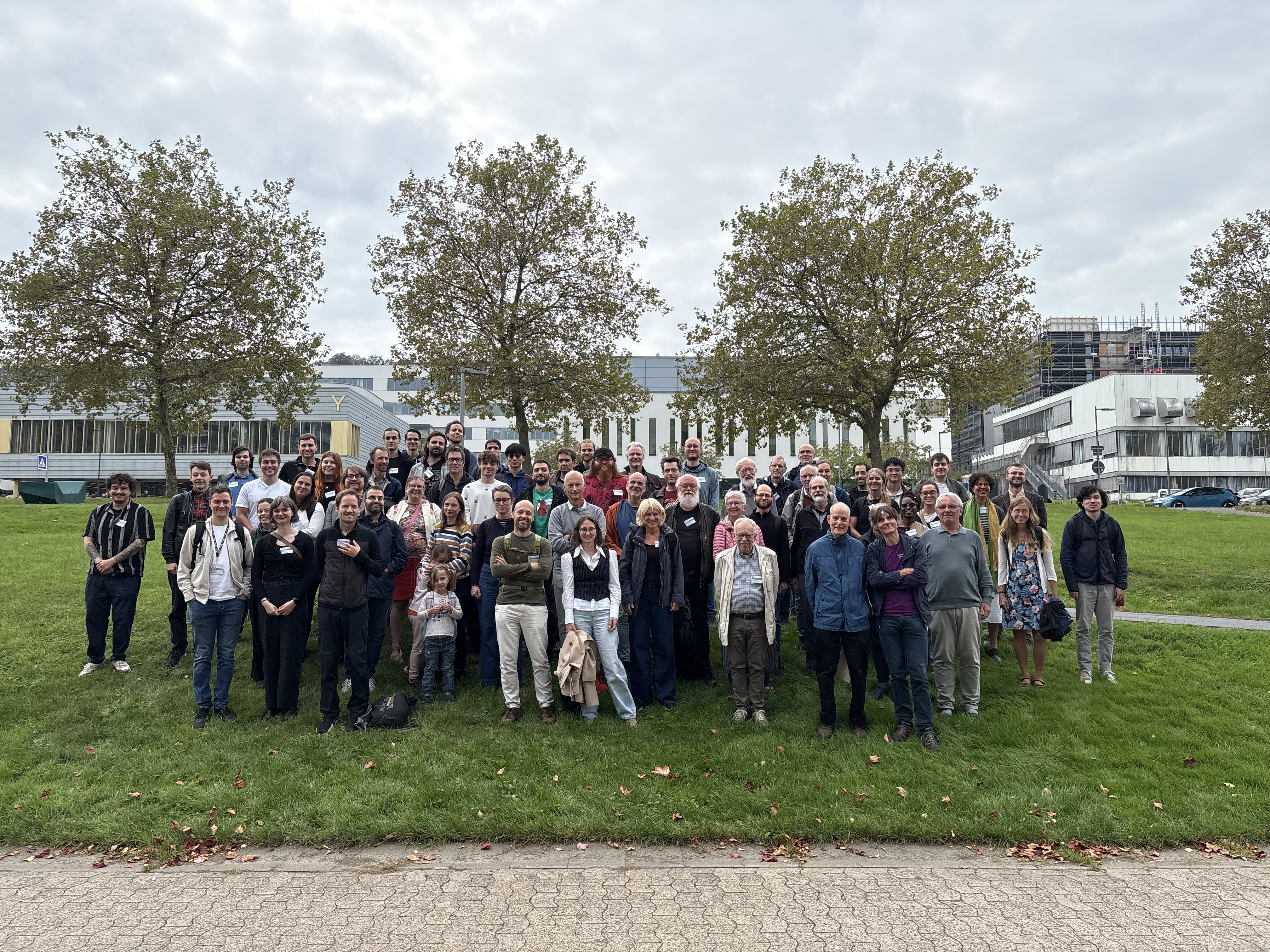
This year's edition of the Buildings workshop was hosted in Bielefeld in honour of Richard Weiss's 80th birthday and also celebrating the retirement of Hendrik Van Maldeghem. In addition to a selection of invited talks, there were contributed talks, in the spirit of the annual Buildings workshops.
Invited Speakers
Contributed Talks
Organizers
- Barbara Baumeister
- Kai-Uwe Bux

Abstracts
Title: On the {i,j}-subgraphs of buildings
Abstract: Let X be a building over the finite type set I, i and j two distinct elements of I and G = G(i,j) the full subgraph of X whose vertices are those of X of either type i or of type j. We (that is Hendrik Van Maldeghem and I) want to deduce properties of G and investigate to which extent, and under which hypotheses, G already determines X. Here are some results:
Theorem 1: G is a connected graph of girth 2m, where the link (or residue) in X of any simplex of cotype {i,j} is a generalized m-gon.
Theorem 2: If m is finite and > 2, then every subgraph of G which is a generalized m-gon is contained in the link of a simplex of X of cotype {i,j}.
Theorem 3: Let X and X' be two irreducible buildings of rank 3 over I = {1,2,3} with finite m = m(1,2) = m'(1,2). If the respective subgraphs G = G(1,2) of X and G' = G'(1,2) of X' are isomorphic, then also X and X' are isomorphic.
In the talk, I will explain these results in more detail and indicate the methods leading to them.
Title: Non-discrete affine buildings
Abstract: The axiomatics of affine ℝ-buildings describes metric spaces that include the simplicial affine buildings, but also contain more non-discrete spaces such as R-trees. We will give examples, discuss completions, flat subsets, and morphisms between buildings (with a view towards affine Λ-buildings). This may include joint work with Lytchak & Hébert and Flamm & Jaeck.
Title: Describing the nub in maximal Kac--Moody groups
Abstract: Let $G$ be a totally disconnected locally compact (tdlc) group. The contraction group $\mathrm{con}(g)$ of an element $g \in G$ is the set of all $h \in G$ such that $g^n h g^{-n} \to 1_G$ as $n \to \infty$. The nub of $g$ can then be characterized as the intersection $\mathrm{nub}(g)$ of the closures of $\mathrm{con}(g)$ and $\mathrm{con}(g^{-1})$.
Contraction groups and nubs provide important tools in the study of the structure of tdlc groups, as already evidenced in the work of G.~Willis. It is known that $\mathrm{nub}(g) = \{1\}$ if and only if $\mathrm{con}(g)$ is closed. In general, contraction groups are not closed and computing the nub is typically a challenging problem.
Maximal Kac--Moody groups over finite fields form a prominent family of non-discrete compactly generated simple tdlc groups. In this talk we give a complete description of the nub of any element in these groups. This is joint work with Timothée Marquis.
Title: Local-to-Global Rigidity of Bruhat-Tits Buildings
Abstract:A vertex-transitive graph X is called local-to-global rigid if there exists a natural number R such that every other graph, whose balls of radius R are isometric to the balls of radius R in X, is covered by X. In 2016 it was shown by De La Salle and Tessera that the 1-skeleton of an affine Bruhat-Tits building of type Ã_n, for n at least 3, is local-to-global rigid if and only if the underlying field has characteristic 0. In this talk I will describe how Amandine Escalier, Hendrik Van Maldeghem and me showed that this also holds for affine Bruhat-Tits buildings of other types.
Title: Generic Chambers, Barycenters, and Boundaries of Affine Buildings
Abstract: Based on two joint papers with Corentin Le Bars, this talk explores the interplay between the geometry of affine buildings and the dynamics of groups acting on their boundaries. We discuss generic triples of antipodal chambers, the construction of equivariant barycenter maps, and applications to boundary dynamics, including C*-simplicity and Poisson boundaries. This provides a common perspective on recent geometric and dynamical results for groups acting on affine buildings.
Title: Presentation of Borel subgroups of Kac-Moody groups over local rings
Abstract: In this talk, I will present ongoing work on showing that the maximal unipotent subgroup (and hence the Borel subgroup) of a (simply laced) Kac-Moody group over a valuation ring is given by the amalgam of its rank 2 subgroups if and only if the Kac-Moody group is 3-spherical. This fact is known for Kac-Moody groups over fields, and in this setting the proof relies on the fact that a certain subcomplex of the associated building is simply connected. I will present an overview of the proof in the field case, and discuss how to prove the analogous statement for more general rings.
Title: Parabolic subgroups of Dyer groups
Abstract: Dyer groups form a class of groups containing Coxeter groups and right-angled Artin groups. We study parabolic subgroups of Dyer groups. In this work we address three main conjectures about these subgroups that remain open in Artin groups. We give an algorithm to decide whether two standard parabolic subgroups are conjugate and describe all conjugating elements in terms of ribbons. As a consequence, we obtain a description of the normaliser of a parabolic subgroup. We also prove the restandardisation property and deduce that arbitrary intersections of parabolic subgroups are parabolic, which implies the existence of parabolic closure for every element. This is joint work with Marina Salamero, Giovanni Sartori and Mireille Soergel.
Title: Fractal apartments in products of trees
Abstract: Among the discrete groups acting geometrically on buildings, irreducible lattices in products of trees play a singular role, notably as a source of torsion-free finitely presented simple groups, following seminal work by Burger-Mozes. In his pioneering work, D. Wise established an irreducibility criterion in terms of the existence of an anti-torus, which is defined as a non-periodic apartment spanned by two periodic lines. An anti-torus gives rise to an aperiodic tiling of the plane. This talk, based on joint work with Justin Vast, is devoted to the discovery that the tilings in question can be fractal. Understanding those fractal apartments has been the goal of a mathematical journey that led us to encounter automatic sequences and affine arithmetic groups.
Title: Double Affine Demazure products and Affine Quantum Bruhat Graphs
Abstract: Hecke algebras are generated by elements whose multiplication is controlled by the corresponding Weyl group. In the q = 0 specialisation, it is determined by the Demazure product in the Weyl group, which is well understood in the finite and affine cases, but is a priori not well-defined in the Kac-Moody affine (double affine) case. Building on work by F. Schremmer, we discuss conjectures and results so far on using the affine quantum Bruhat graph to define a double affine Demazure product.
Title: The quest for the smallest non-cyclic quotient of the Artin group E_8
Abstract: In this talk I will discuss how to compute the smallest non-cyclic quotient of a spherical Artin group. I will give particular focus to Kolay's Theorem about braid groups and also to the exceptional Artin groups E_6, E_7, and E_8. Based on joint work with Thomas Ng, Kaitlin Ragosta, Nancy Scherich, and Yvon Verberne.
Title: The Classification of the 2-generated primitive Axial Algebras of Monster Type
Abstract: Axial algebras of Monster type (α, β) arise naturally as a generalisation of the weight 2 components of OZ-type vertex operator algebras by axiomatising some of their relevant properties. The motivating examples of axial algebras of Monster type are the Conway-Norton-Griess algebra, which is the weight 2 component of the Moonshine VOA and whose automorphims group is the Monster simple group, and its Norton-Sakuma subalgebras. This class also includes Matsuo algebras, related to 3-transposition groups, and Jordan algebras. Moreover, axial behaviour has also been detected elsewhere, in Chayet-Garibaldi algebras which are related to algebraic groups and whose fusion law is remarkably close to the Monster type fusion law, and in Hsiang algebras, arising from PDEs. A central issue in this context has been the classification of the 2-generated primitive axial algebras of Monster type. This problem was originally attacked by Rehren around 2015. A huge milestone was accomplished by Yabe in 2023 leading, with additional cases completed by Franchi, Mainardis, and McInroy, in 2022 and 2024, to the classification in the symmetric case. In this talk we shall expose the full classification (i.e. including the non-symmetric case) recently obtained in joint work with Justin McInroy and Michael Turner.
Title: Vertex Stabilizers in (Locally) s‑Arc‑Transitive Graphs
Abstract: The structure of vertex stabilizers in (locally) s‑arc‑transitive graphs was first investigated in depth by Weiss, Trofimov, Stellmacher, and Van Bon. In this talk we give a brief overview of what is known and discuss some recent results.
Title: Involutions
Abstract: We investigate interesting fixed point structures of involutions acting on spherical buildings (mainly of exceptional type). We discover unexpected inclusions and highlight some combinatorial properties and connections.
Title: $AG_2$-graded Lie algebras
Abstract: Recently, Bernhard Mühlherr and Richard Weiss have discovered a class of Tits hexagons related to the (generalized) root system $AG_2$. They found two different families of examples: one class related to skew-hermitian forms and another class related to the exceptional groups $F_4$, $E_6$, $E_7$, and $E_8$, but the precise underlying algebraic structure remains mysterious.
We approach this problem from a different angle, starting from Lie algebras graded by the root system $AG_2$, in the sense of Berman and Moody. It turns out—assuming char(k) is not 2 or 3—that such a Lie algebra is parametrized by a structurable algebra equipped with a “conjugate-supplementary idempotent”, i.e., an idempotent $t$ such that $t + \overline{t} = 1$. We can completely classify these examples, and in particular, we find that in the “most interesting” case, we recover the two classes found by Mühlherr and Weiss.
Title: Tits hexagons and hexagonic spaces
Abstract: Tits polygons are natural generalizations of Moufang polygons. Examples of Tits polygons can be obtained from spherical Moufang buildings using Tits indices. There are two families of Tits hexagons arising in this fashion. They are called of type $G_2$ and of type $AG_2$. In my talk I will recall the basics on Tits polygons with a special focus on the hexagon case. The aim is to explain two recent results: The first one (joint with Richard Weiss) is a partial classification of Tits hexagons of type $AG_2$. The second one (joint with Hendrik Van Maldeghem) is a point-line characterization of thick spherical buildings that is closely related to the combinatorics of the Tits hexagons of type $G_2$.
Title: Non-crossing partitions for exceptional hereditary curves
Abstract: We introduce the notion of reflection groups of canonical type, which arise from Lenzing’s K-theoretic study of the canonical algebras introduced by Ringel. We establish a bijection between the non-crossing partitions associated with these groups and certain subcategories of coherent sheaves on an exceptional hereditary curve defined over an arbitrary field. Combined with a result of Hubery and Krause, this completes the programme of categorification of generalised non-crossing partitions. The work presented in this talk is joint with Barbara Baumeister, Igor Burban, and Charly Schwabe.
Title: The Geometry and Structure of Shephard groups
Abstract: Shephard groups are a class of groups that generalize both Coxeter and Artin-Tits groups. In a Shephard group, generators have orders in $\mathbb{N}_{\geq 2} \cup \{\infty\}$, and pairs of generators are subject to Artin-Tits relations. While these groups include both Coxeter groups (where all generators have order 2) and Artin-Tits groups (where all generators have infinite order), many properties of the prior groups are still unknown for Shephard groups.
In this talk, I will cover some of the open questions regarding Shephard groups, with particular focus on the intersection of parabolic subgroups, a problem well-understood in the Coxeter and Artin-Tits cases but largely open for Shephard groups. Furthermore, I will present results concerning the natural coset geometries associated with these groups, and which properties these geometrical structures will have.
This is a joint work with Travis Scrimshaw and Philippe Tranchida
Title: Tamagawa numbers in positive characteristic: an elementary proof of invariance under passing to inner forms
Abstract: Let $G_1 / K$ and $G / K$ be two semisimple, simply-connected groups defined over a global function field $K$, which are inner forms of each other. We give a short proof for the equality of the Tamagawa number, $\tau(G_1) = \tau(G).$ It is equal to $1$ (Gaitsgory-Lurie, 2019). It is done by interpreting the elements in double cosets $G(K) \backslash G(\mathbb{A}) / \mathcal{K}$ as points of certain moduli stacks $\mathcal{M}_G / \mathbb{F}_q$. We relate the Tamagawa number to traces of the Frobenius acting on $\ell$-adic cohomology groups. To construct these moduli stacks we use explicit formulas for $1$-cocycles which represent the relevant Galois-cohomology classes. These $1$-cocycles respect certain parahoric subgroups corresponding to points in the Bruhat-Tits building.
This is joint work with R. Bitan, G. Harder, R. Koehl and A. Zidani
Title: Conjugator length for (affine) Coxeter groups and their friends
Abstract: The conjugator length function of a finitely generated group G serves as a measure of complexity for conjugation in G. In this talk I will explain this concept. Moreover I will report on joint work with Santos-Rego in which we compute the growth of the conjugature length function using a geometric description of transporting sets in rank n affine Coxeter groups in terms of their natural action on (n-1)-dimensional vector spaces.
Title: Visualising conjugation in Euclidean isometry groups
Abstract: Let W be an affine Coxeter group. For x, y in W, write [x] for the conjugacy class of x, and C(x,y) for the coconjugation set i.e. all elements of W which conjugate x to y. I will demonstrate an app, developed with Amy Herron, to visualise conjugacy classes and coconjugation sets in 2- and 3-dimensional cases. These geometric descriptions of [x] and C(x,y) are a consequence of joint work with Elizabeth Milicevic and Petra Schwer, and our descriptions hold for much more general groups of Euclidean isometries, as I will explain.
Title: Two-dimensional Euclidean buildings are intricate
Abstract:Two-dimensional Euclidean buildings can be roughly classified by basic combinatorial data: type and thickness(es). However, each class contains many buildings that differ in more subtle ways. I will speak about properties that only depend on the basic combiatorial data and ones that distinguish between the more subtle properties. I will especially be interested in embeddings of finite subcomplexes and how they allow to construct various measures on the boundary. This is based on joint work with Jean Lécureux.
Practical Information
📍 Venue
Universität Bielefeld
Universitätsstraße 25, 33615 Bielefeld, Germany
The workshop will take place on the main campus. The lecture hall is V2-205.
🚆 Bielefeld Hauptbahnhof is about 15 min by Stadtbahn (Line 4 towards "Universität"). For detailed timetables and connections, please visit the moBiel website.
🏨 Accommodation – Workshop Contingents
After registering, you will receive a personal discount code for the following hotels:
Registration
⚠️ Warning:
The organizers and listed hotels will never contact you directly to request bookings or payment details. Any unsolicited accommodation offers are scams and must be ignored.